
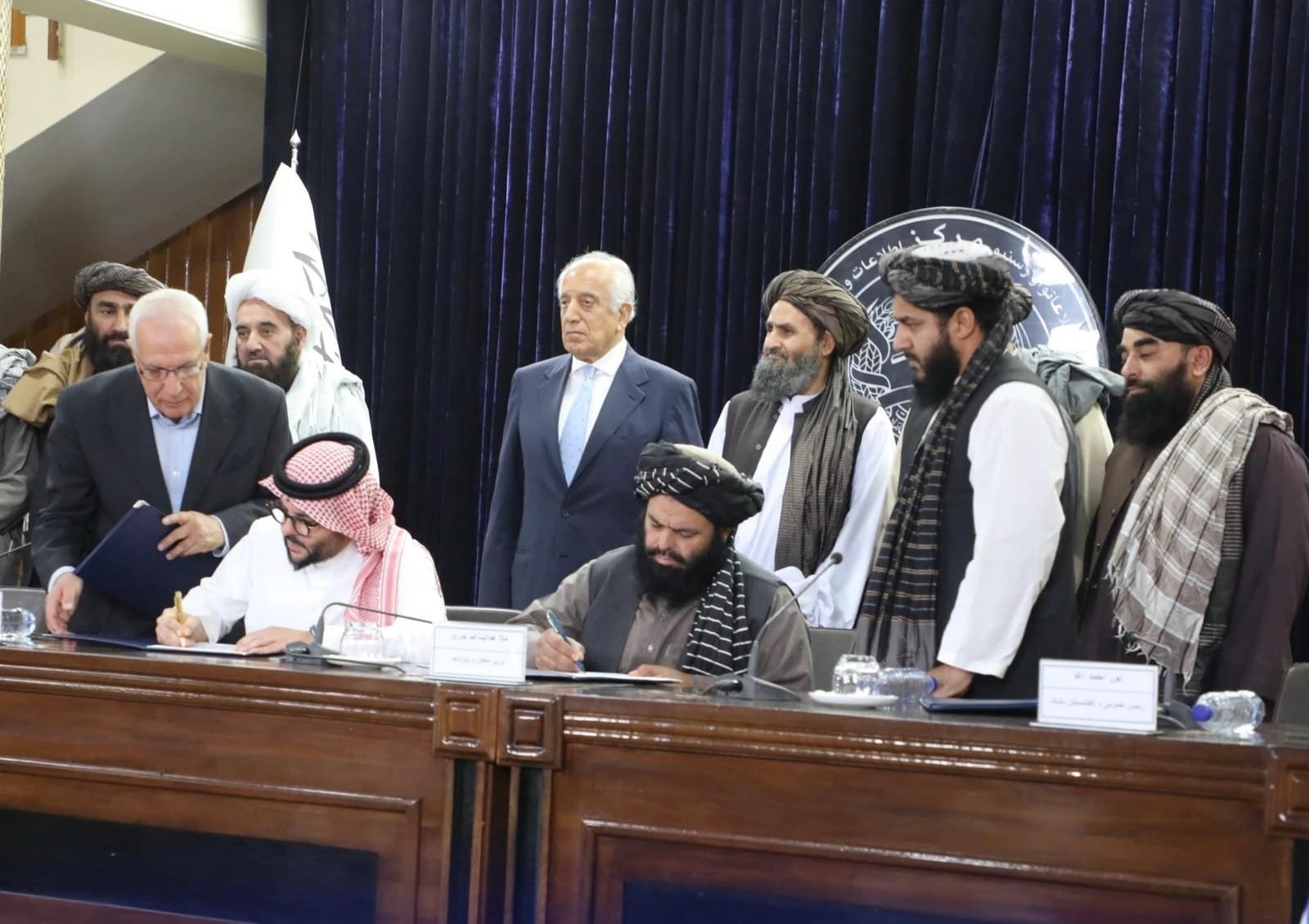
On September 7, 2026, Afghanistan’s Taliban-run Ministry of Mines and Petroleum signed a contract with Saudi Arabia’s Delta International for exploration and extraction rights in the Kushk–Tirpul oil and gas basin, a roughly 22,000-square-kilometre stretch of western Afghanistan spanning Herat and Badghis provinces. The agreement represents one of the largest publicly announced foreign energy commitments to Afghanistan since the Taliban returned to power in 2021.
Under the deal, Delta will commit an initial $200 million to exploration and extraction across seven gas blocks in the basin. The exploration phase is set to run eight years, with the overall contract structured to last 25 years. Afghan officials, per Deputy Prime Minister for Economic Affairs Abdul Ghani Baradar, have said the wider Kushk-Tirpul programme could eventually attract as much as $50 billion in investment over 25 years, with Delta separately floating a figure as high as $60 billion over a 10-year horizon.
Taliban Deputy Prime Minister Mullah Abdul Ghani Baradar, Da Afghanistan Bank Governor Noor Ahmad Agha, Islamic Emirate spokesperson Zabihullah Mujahid, and former U.S. Special Representative for Afghanistan Zalmay Khalilzad, who had met Taliban officials separately two days earlier, attended the signing ceremony in Kabul. Khalilzad called the deal a “positive and promising” signal that Afghanistan was ready for large-scale investment. The contract itself was signed by Taliban Minister of Mines and Petroleum Hedayatullah Badri and Delta International CEO Shaher Al-Taqi, who thanked his Afghan counterparts and described the arrangement as a “win-win” partnership.
A relationship months in the making
The September signing was not a sudden development. Afghan officials disclosed on September 5, two days before the contract was finalised, that Al-Taqi had met with Minister Badri to discuss investment in Afghanistan’s oil and gas sector. That meeting itself built on groundwork laid earlier in the year: in February 2026, Baradar’s office confirmed that Delta had expressed formal interest in investing in the Turkmenistan–Afghanistan–Pakistan–India (TAPI) gas pipeline, including purchasing gas under the TAPI framework, supporting expansion of Turkmenistan’s Galkynysh gas field, and building a pipeline linking Herat’s Ghore district to Spin Boldak in Kandahar, with discussions also touching on a possible gas hub at Gwadar port in Pakistan.
That pipeline ambition has since taken shape as a distinct project. Delta has said it is studying a proposed 700-kilometre gas pipeline running from Herat to near Spin Boldak, estimated to cost roughly $10 billion, contingent on feasibility studies, financing, and regulatory approval. Company materials have informally dubbed the wider regional vision “CentGas,” a name that echoes a 1997 consortium of the same name that once attempted, and abandoned, a similar Turkmen-gas-through-Afghanistan pipeline concept. Analysts covering the deal have been careful to note that the new Guzara–Spin Boldak route is not formally part of TAPI itself; under TAPI, Turkmenistan remains the gas source and Afghanistan merely a transit corridor, whereas Delta’s separate programme is aimed first at developing Afghanistan’s own domestic gas resources.
Who is behind Delta
Delta International’s chairman is Badr Mohammed Al-Aiban, who has described the Afghanistan investment as extending beyond industrial activity toward building out the country’s broader energy ecosystem. Shaher Al-Taqi serves as the company’s CEO and has been the public face of negotiations with Kabul throughout 2026.
Alongside the Kushk-Tirpul contract, Afghanistan’s mines ministry also signed separate agreements worth $13.8 million with Russia’s TNG company on the same day, covering supervisory and consultancy work on the Amu Darya basin and construction of a production facility at the Zamrad Sai block, a reminder that Kabul is courting multiple foreign energy partners simultaneously, not exclusively Gulf capital.
Why it matters regionally
The deal lands at a moment of heightened economic urgency for Afghanistan, which imports more than 90 per cent of its petroleum needs and has faced chronic fuel shortages; fuel prices in Kabul reportedly rose sharply between July and August 2026. It also arrives roughly a month after Saudi Arabia, Pakistan, and Turkey signed the Makkah Joint Defence Agreement on August 7, 2026, a trilateral security pact whose members now find their interests diverging somewhat as Riyadh deepens a separate economic relationship with the Taliban government even as Islamabad and Kabul remain at odds over border and security disputes.
Separately, and around the same period, the Taliban’s Ministry of Higher Education revoked the operating license of Khatam al-Nabieen University in Kabul and ordered the closure of its branch in Ghazni, citing unspecified policy violations. The university’s owner, Mohammad Jawad Mohseni, has publicly rejected the ministry’s justification, saying no evidence, documentation, or specific examples have ever been provided to support the allegations. It’s worth being precise here: no credible reporting has established a confirmed link between this closure and the Delta energy deal, and the Taliban has not cited any such connection. The two events are simply contemporaneous.
What comes next
For now, Kushk-Tirpul remains an exploration contract, not a producing field. Delta’s own public statements make clear that the larger $50–60 billion vision, and any pipeline to Pakistan or Gwadar, depends on exploration results, proven reserves, technical feasibility, financing, and final investment decisions still years away. What is confirmed is narrower but still significant: Saudi private capital now has a direct, contractual foothold in Afghanistan’s energy sector for the first time at this scale, at a moment when regional energy politics, TAPI’s slow progress, Pakistan-Afghanistan tensions, and shifting Gulf-Central Asian alignments, are all in motion at once.